Summary
An AI chatbot for small business is an artificial-intelligence-powered assistant that helps businesses communicate with customers and website visitors automatically. It can answer common questions, explain products and services, guide visitors, provide support, qualify leads, and operate outside normal business hours.
For small businesses, this technology can be particularly useful because customer support and sales teams are often smaller than those of larger organizations. Instead of requiring employees to answer every repetitive question manually, an AI chatbot can handle many routine conversations while human team members focus on more complicated customer needs.
A website AI chatbot can be trained or connected to business information such as website pages, FAQs, blogs, documentation, service pages, product information, PDFs, and knowledge-base articles.
For example, TheSiteGPT describes its platform as an AI chatbot for WordPress websites that can learn from website content and answer visitor questions, generate leads, and provide automated 24/7 support. Its current website says the system can process pages, FAQs, blogs, documentation, PDFs, case studies, product documentation, and service pages.
This guide explains how AI chatbots work for small businesses, their benefits, use cases, important features, costs, implementation process, SEO opportunities, limitations, best practices, and frequently asked questions.
Introduction: Why Small Businesses Are Turning to AI Chatbots
Running a small business often means managing many responsibilities with a limited team.
A business owner or small team may simultaneously handle:
- Sales
- Customer support
- Marketing
- Website management
- Lead generation
- Social media
- Administration
- Product questions
- Technical support
Customer questions can consume a surprising amount of time.
A visitor might ask:
“What services do you provide?”
Another customer might ask:
“How much does your product cost?”
Someone else may want to know:
“Do you provide support on weekends?”
These questions may be simple, but answering them repeatedly can take valuable employee time.
An AI chatbot for small business provides a way to automate many of these routine conversations.
Instead of searching through a website or waiting for an email response, visitors can ask questions directly through a chat interface.
The chatbot can then use its available knowledge to provide an answer.
This makes AI chatbots useful not only for large enterprises but also for:
- Local businesses
- Freelancers
- Agencies
- Consultants
- Online stores
- SaaS startups
- Coaches
- Educational businesses
- Service providers
- WordPress websites
What Is an AI Chatbot for Small Business?
An AI chatbot for small business is a conversational software system designed to communicate with customers using artificial intelligence.
It can be placed on a website and configured around the specific business.
Unlike a simple rule-based chatbot, an AI chatbot can understand natural-language questions.
For example, a traditional chatbot might expect:
“Pricing”
An AI chatbot may understand:
“I’m a small company with five employees. Which plan would be suitable for us?”
The second question contains more context and does not necessarily follow a predefined format.
Modern AI systems can analyze the meaning and intent of these questions and generate responses based on their available information.
How Does an AI Chatbot for Small Business Work?
A typical AI chatbot follows several stages.
1. Connect the Business Website
The chatbot first needs access to relevant business information.
Depending on the platform, the business may provide:
- Website URL
- Website pages
- FAQs
- Documentation
- PDFs
- Product information
- Service information
- Knowledge-base articles
TheSiteGPT’s current process starts by allowing a business to add its website URL so the platform can scan the website content.
2. Train or Index the Information
The chatbot processes the available content.
For example, a small web development agency might have:
- WordPress development pages
- SEO service pages
- Pricing information
- Portfolio pages
- FAQs
- Blog posts
The AI can use this information as part of its knowledge system.
TheSiteGPT states that its AI can automatically learn from pages, FAQs, blogs, and documentation and create a searchable website knowledge engine.
3. Visitor Asks a Question
A visitor might ask:
“Do you build WooCommerce websites?”
The AI analyzes the question.
4. Find Relevant Information
The chatbot searches its knowledge sources for relevant information.
Semantic search can be particularly useful because customers don’t always use the same words as the business.
For example:
“Can you make an online store using WordPress?”
may relate to content discussing:
WooCommerce development.
TheSiteGPT currently describes its semantic-search functionality as understanding visitor intent and finding relevant answers.
5. Generate the Response
The AI generates a response using the information available to it.
Instead of forcing the customer to search through multiple pages, the chatbot can provide a conversational answer.
6. Continue the Conversation
The visitor can ask a follow-up question.
For example:
Visitor:
“Do you build WooCommerce websites?”
Chatbot:
“Yes, we provide WooCommerce development.”
Visitor:
“How long does it take?”
A conversational AI system can use the previous context to understand what “it” refers to.
Why Is an AI Chatbot Useful for Small Businesses?
Large organizations may have entire departments dedicated to customer service.
Small businesses often don’t.
That creates a common challenge:
More customers = more questions = more support workload.
An AI chatbot can help businesses scale communication without requiring every question to be answered manually.
The goal isn’t necessarily to replace employees.
Instead, the chatbot can handle routine interactions while people handle situations that require human judgment.
Benefits of an AI Chatbot for Small Business
1. 24/7 Customer Support
A small business may not have employees available around the clock.
An AI chatbot can remain available on the website even when the team is offline.
Visitors can potentially receive answers:
- Before business hours
- After business hours
- On weekends
- During holidays
- Across different time zones
TheSiteGPT currently positions its website chatbot around automated 24/7 support.
2. Reduce Repetitive Customer Questions
Consider a small business receiving dozens of questions every week about:
- Pricing
- Services
- Features
- Availability
- Refunds
- Delivery
- Documentation
- Setup
- Compatibility
Many of these questions can be answered using existing business information.
An AI chatbot can automate supported repetitive questions, allowing employees to spend more time on complex tasks.
3. Save Employee Time
Time is especially valuable for a small business.
If employees repeatedly answer the same questions, that time could instead be spent on:
- Sales
- Product development
- Customer relationships
- Marketing
- Operations
- Business growth
Automating routine conversations can help shift human effort toward higher-value work.
4. Generate Leads
A small business website isn’t only a source of information.
It is also a potential sales channel.
An AI chatbot can ask questions such as:
“What service are you interested in?”
“What type of business do you operate?”
“When are you looking to get started?”
“Would you like someone from our team to contact you?”
This can help identify potential customers.
TheSiteGPT currently lists lead generation and lead analytics among its features.
5. Improve Website Engagement
A visitor who cannot find information may leave.
A chatbot creates an additional way to interact with the website.
Instead of navigating through:
Home → Services → FAQ → Pricing
the visitor can simply ask:
“How much does your WordPress service cost?”
This can make information discovery easier.
6. Provide Faster Answers
Small businesses sometimes have limited support capacity.
A chatbot can provide immediate automated responses to supported questions instead of requiring every visitor to submit a form.
This can make the first interaction faster.
7. Help Visitors Find the Right Service
A business may offer several services.
For example:
- Website development
- SEO
- Website maintenance
- Speed optimization
- Plugin development
- Digital marketing
A visitor might not know which service they need.
The chatbot can ask questions and guide them toward relevant information.
8. Support Multiple Languages
Some small businesses serve customers internationally.
A multilingual chatbot can potentially make communication easier for visitors who prefer different languages.
TheSiteGPT currently advertises support for more than 100 languages.
Businesses should test the languages relevant to their specific audience before relying on multilingual support.
9. Understand What Customers Want
Chatbot conversations can reveal customer questions that aren’t obvious from website analytics alone.
Suppose visitors repeatedly ask:
“Do you offer emergency support?”
If the website doesn’t clearly explain emergency support, the repeated questions reveal a content gap.
Businesses can use these insights to improve:
- FAQs
- Service pages
- Blog posts
- Documentation
- Product pages
10. Compete With Larger Businesses on Customer Experience
A small company may not have a large customer-service department.
However, a well-designed AI chatbot can provide an always-available digital support layer.
This can help a small business create a more accessible online experience without building a large support operation.
Best AI Chatbot Features for Small Businesses
When choosing an AI chatbot, small businesses should focus on features that directly support their goals.
Website Content Training
The chatbot should be able to work with the information that makes the business unique.
Useful sources include:
- Website pages
- FAQs
- Blogs
- Documentation
- PDFs
- Product pages
- Service pages
- Knowledge-base articles
TheSiteGPT says its knowledge engine can read website pages, PDFs, blogs, case studies, product documentation, FAQs, and service pages.
Semantic Search
Customers rarely phrase questions exactly like website content.
A semantic search system can focus on the meaning of a question.
For example:
“I need someone to fix my slow WordPress site.”
could connect with content about:
WordPress performance optimization.
This makes conversational support more natural.
Lead Generation
A small business often needs both support and sales assistance.
A chatbot that can capture leads can help turn website conversations into potential opportunities.
Useful lead fields may include:
- Name
- Phone
- Company
- Service requirement
- Project type
- Budget
- Timeline
Businesses should only collect information they actually need and handle customer information according to applicable privacy requirements.
Analytics Dashboard
Analytics can help answer questions such as:
- How many visitors use the chatbot?
- What are people asking?
- Which questions are most common?
- Which questions aren’t answered?
- How many leads were captured?
- Which topics generate the most conversations?
TheSiteGPT currently describes an AI analytics dashboard for tracking conversations, engagement, and chatbot performance.
Human Handoff
AI shouldn’t be the only support option.
A good system should provide a way to escalate appropriate conversations to humans.
Examples include:
- Complex complaints
- Billing disputes
- Sensitive requests
- Difficult technical issues
- High-value sales opportunities
- Account-specific problems
The chatbot handles the first layer; human staff handle cases requiring additional expertise.
AI Chatbot Use Cases for Small Businesses
1. Local Service Businesses
Examples include:
- Plumbers
- Electricians
- Consultants
- Repair businesses
- Cleaning companies
- Marketing agencies
- Web development agencies
The chatbot can answer:
- What services do you provide?
- What areas do you serve?
- How can I request a quote?
- What are your business hours?
- How do I contact you?
2. Small E-Commerce Businesses
An AI chatbot can help customers with:
- Product discovery
- Product questions
- Comparisons
- Shipping information
- Return policies
- Product recommendations
- Frequently asked questions
For example:
“I’m looking for a gift under ₹2,000.”
A chatbot connected to appropriate product information could guide the shopper toward relevant options.
3. Small SaaS Companies
A small software company may have limited customer-support resources.
An AI chatbot can assist with:
- Product features
- Pricing
- Documentation
- Setup
- Onboarding
- Troubleshooting
- Integration questions
TheSiteGPT currently lists SaaS as one of its chatbot use cases and describes automated support and customer onboarding as applications.
4. Freelancers and Consultants
Freelancers can use an AI chatbot to explain:
- Services
- Packages
- Process
- Availability
- Pricing structure
- Project requirements
It can also collect initial project information before the freelancer speaks directly with a prospect.
5. Digital Agencies
Agencies often answer many pre-sales questions.
An AI assistant can help explain:
- Website development
- SEO
- PPC
- Social media marketing
- Branding
- Website maintenance
- Development timelines
It can also help qualify prospects.
TheSiteGPT currently describes an agency AI assistant use case focused on instant answers and lead qualification.
6. Educational Businesses
Small education companies can use AI assistants for:
- Course information
- Admission questions
- Fees
- Class schedules
- Learning resources
- FAQs
TheSiteGPT also identifies education as a chatbot use case for learning and support assistance.
AI Chatbot for Small Business Websites
A website chatbot can become a central information layer for a small business.
Consider a typical website containing:
- Home page
- About page
- Services
- Pricing
- Blog
- FAQs
- Contact page
- Documentation
Instead of expecting every visitor to navigate those pages manually, the chatbot can provide another discovery mechanism.
For example:
“What services do you provide?”
The chatbot can explain the relevant services.
Then:
“Which service would help improve my website speed?”
It can guide the visitor toward relevant information if that information exists in its knowledge base.
AI Chatbot for WordPress Small Businesses
WordPress is widely used by small businesses because it provides a flexible platform for building business websites.
An AI chatbot can be added to a WordPress site through a dedicated plugin, embedded service, script, or integration, depending on the provider.
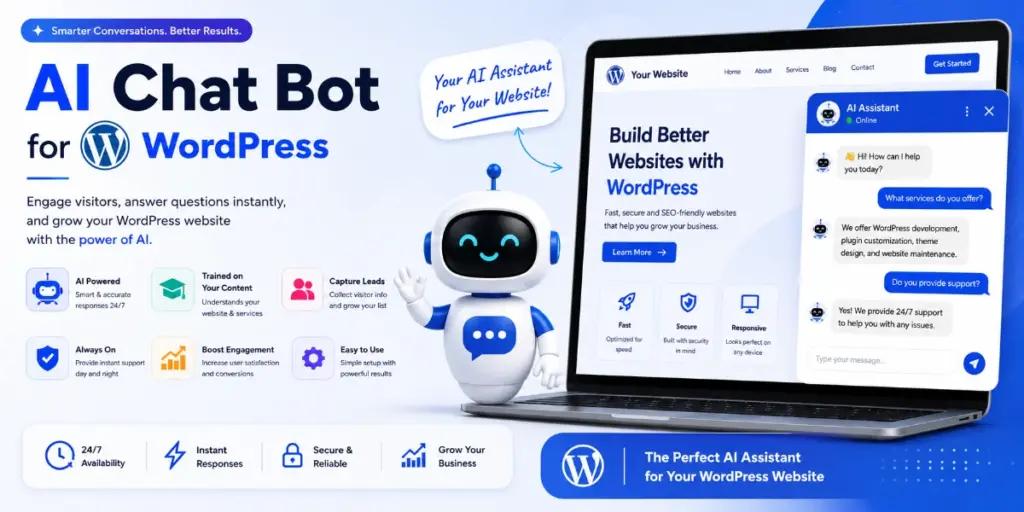
TheSiteGPT specifically markets itself as an AI chatbot for WordPress websites and describes a no-code setup process in which users connect their website, train the AI using site content, build a knowledge base, and answer visitor questions automatically.
This can be useful for WordPress sites that already have substantial information available across pages and blog content.
How to Add an AI Chatbot to a Small Business Website
Step 1: Identify Your Main Objective
Decide what the chatbot should do.
For example:
Goal 1: Answer FAQs
Goal 2: Generate leads
Goal 3: Provide customer support
Goal 4: Help users find products
Goal 5: Reduce repetitive support requests
Start with a clear objective rather than trying to automate everything immediately.
Step 2: Collect Your Business Information
Gather:
- Website pages
- FAQs
- Product descriptions
- Service pages
- Pricing
- Policies
- Documentation
- Blog posts
- PDFs
Remove outdated information before connecting it to the chatbot.
Step 3: Connect Your Website
Depending on the platform, this may involve:
- Adding a website URL
- Installing a WordPress plugin
- Adding JavaScript
- Connecting an API
- Uploading documents
TheSiteGPT currently describes a URL-based workflow where the website is connected and its content is scanned.
Step 4: Train or Index the Knowledge
Allow the chatbot system to process your business information.
Check that important pages have been included.
Step 5: Customize the Chatbot
Customize:
- Logo
- Colors
- Welcome message
- Tone
- Chat position
- Suggested questions
- Lead form
- Human contact options
The chatbot should visually fit your website.
Step 6: Test Real Customer Questions
Don’t only test perfect questions.
Try:
“how much?”
“can u help me with website”
“do you work with wordpress?”
“I need seo for my business”
“which plan is best?”
“can I talk to someone?”
Test different ways real customers might communicate.
Step 7: Monitor and Improve
After launch, review chatbot conversations.
Look for:
- Unanswered questions
- Incorrect answers
- Repeated questions
- Missing information
- Potential leads
- Confusing conversations
Then improve your website and knowledge base.
AI Chatbot Pricing for Small Businesses
Cost is an important consideration for a small business.
Pricing varies based on:
- Number of websites
- AI capabilities
- Message limits
- Knowledge-base size
- Analytics
- Lead generation
- Integrations
- Customer support
- Hosting
- Enterprise features
Common pricing models include:
- Monthly subscriptions
- Annual plans
- Lifetime licenses
- Usage-based pricing
- Per-message pricing
- Enterprise pricing
As of the current information displayed on TheSiteGPT website, its listed plans include a yearly option at ₹1,999, a lifetime option at ₹3,499, and a reseller option at ₹14,999. The displayed yearly and lifetime plans include one website, unlimited AI messages, dashboard AI responses, lead analytics, and email support, while the reseller plan lists support for up to 10 websites.
Pricing can change, so the live pricing page should be checked before making a purchasing decision.
Is an AI Chatbot Affordable for a Small Business?
An AI chatbot can be financially practical when the business receives enough repetitive questions to justify automation.
For example, consider a company that spends several hours every week answering basic questions.
If an AI chatbot can reliably handle a portion of those conversations, employees may have more time for other activities.
However, businesses should evaluate the total cost, including:
- Software
- Setup
- Integration
- Maintenance
- Human support
- Knowledge-base management
The right solution depends on the business’s specific support volume and requirements.
AI Chatbot for Small Business and Lead Generation
One of the most interesting applications is combining customer support with sales qualification.
A visitor might ask:
“Do you provide SEO?”
The chatbot answers.
Then it can ask:
“Would you like help choosing an SEO package?”
The visitor says:
“Yes.”
The chatbot can then collect:
- Name
- Website URL
- Business type
- SEO requirements
This creates a conversational lead-generation funnel.
Instead of forcing every visitor to complete a long contact form, the business can gather information progressively.
AI Chatbot and Small Business SEO
An AI chatbot isn’t a direct replacement for SEO.
Adding a chatbot does not automatically make a website rank higher.
However, it can provide valuable SEO insights.
Find Content Gaps
If customers repeatedly ask questions that aren’t answered on your website, create content around those questions.
Discover Long-Tail Topics
Customer questions can inspire long-tail keywords.
For example:
“Can I use your service with WooCommerce?”
could become an article targeting:
“Can [service] work with WooCommerce?”
Improve Internal Navigation
The chatbot can help visitors discover:
- Service pages
- Product pages
- Blog posts
- Documentation
- Contact pages
How to Make an AI Chatbot More Accurate
Keep Content Updated
If your pricing changes, update your information.
If a service is discontinued, remove it.
If a product changes, update the documentation.
Create Detailed FAQs
Good FAQs give the AI clear information to work with.
Include questions about:
- Pricing
- Features
- Setup
- Compatibility
- Refunds
- Support
- Availability
- Policies
Set Clear Boundaries
The chatbot should not invent:
- Pricing
- Discounts
- Guarantees
- Product features
- Policies
- Legal information
If the answer isn’t available, the chatbot should say so and provide an appropriate next step.
AI Chatbot Security and Privacy
Small businesses should not overlook security simply because their company is small.
Before choosing an AI chatbot, review:
- Privacy policy
- Data handling
- Data retention
- Security practices
- Third-party integrations
- Customer information storage
- Access controls
- Compliance requirements
TheSiteGPT currently advertises GDPR compliance and enterprise-oriented security positioning on its website. Businesses should nevertheless review the provider’s current privacy and security documentation and determine whether it meets their particular requirements.
If your chatbot handles sensitive information, additional security and regulatory considerations may apply.
Common Mistakes Small Businesses Make With AI Chatbots
1. Using a Generic Chatbot
A chatbot needs business-specific knowledge to provide useful answers.
2. Uploading Outdated Information
Old information can lead to incorrect customer responses.
3. Automating Everything
Not every customer interaction should be automated.
4. Ignoring Human Support
Customers should have an appropriate path to human assistance.
5. Not Reviewing Conversations
Chatbot conversations contain valuable information about customer needs.
6. Making the Chatbot Too Aggressive
Avoid constantly opening chat windows or interrupting users.
7. Collecting Too Much Information
Only ask customers for information that is necessary.
Best Practices for an AI Chatbot for Small Business
Follow these practical guidelines:
- Start with common FAQs.
- Train the chatbot using accurate business information.
- Keep the knowledge base updated.
- Use a natural conversational tone.
- Make the chatbot mobile-friendly.
- Provide human escalation.
- Monitor unanswered questions.
- Use analytics.
- Connect chatbot conversations with your content strategy.
- Test before publishing.
- Review conversations regularly.
- Avoid unsupported claims.
- Protect customer information.
- Keep the chat interface simple.
- Measure results instead of assuming success.
How to Measure AI Chatbot Success
Installing a chatbot isn’t enough.
Small businesses should measure whether it is actually helping.
1. Conversation Volume
How many visitors use the chatbot?
2. Question Resolution
How many questions receive useful answers?
3. Escalation Rate
How frequently do customers need human support?
4. Lead Generation
How many leads are generated through conversations?
5. Conversion Rate
How many chatbot interactions lead to:
- Contact forms
- Purchases
- Bookings
- Demos
- Consultations
6. Unanswered Questions
Which questions does the chatbot struggle with?
These questions can help identify missing website content.
AI Chatbot vs Human Customer Support
The most practical approach for many small businesses is not AI versus humans.
It is AI plus humans.
AI can handle:
- FAQs
- Basic product questions
- Website navigation
- Documentation
- Basic troubleshooting
- Lead qualification
Humans can handle:
- Complex complaints
- Sensitive situations
- Billing disputes
- Difficult technical problems
- High-value sales
- Special cases
This division allows each system to handle the type of work it is best suited for.
Future of AI Chatbots for Small Businesses
AI chatbots are moving beyond basic question-and-answer systems.
Increasingly, AI assistants can become interfaces through which customers interact with business systems.
Future customer interactions may involve requests such as:
“Help me choose a plan.”
“Book a consultation.”
“Find the right product.”
“Show me the documentation.”
“Connect me with an expert.”
“Help me solve this problem.”
This means a small business website can evolve from a collection of static pages into a more interactive digital experience.
Frequently Asked Questions
1. What is an AI chatbot for small business?
An AI chatbot for small business is an artificial-intelligence-powered assistant that communicates with website visitors and customers, answers questions, provides information, supports users, and can assist with lead generation.
2. Is an AI chatbot useful for a small business?
Yes. Small businesses can use AI chatbots to answer repetitive questions, provide 24/7 assistance, guide visitors, qualify leads, and reduce manual support workload.
3. Can an AI chatbot work on a small business website?
Yes. AI chatbots can be integrated into websites using plugins, embedded services, scripts, or APIs, depending on the platform.
4. Can an AI chatbot work with WordPress?
Yes. WordPress websites can use AI chatbot plugins and external chatbot services. TheSiteGPT specifically markets an AI chatbot for WordPress websites.
5. Can an AI chatbot answer questions about my business?
Yes, when it has access to accurate business information. Website pages, FAQs, documentation, product information, and service pages can provide knowledge sources depending on the chatbot platform.
6. Can an AI chatbot generate leads?
Yes. An AI chatbot can ask qualifying questions and collect contact details from potential customers.
7. Can an AI chatbot provide 24/7 support?
Yes. AI chatbots can operate continuously and answer supported questions outside normal business hours.
8. How much does an AI chatbot for small business cost?
Costs vary by provider, features, usage, integrations, number of websites, and support. Some providers offer monthly or annual subscriptions, while others offer lifetime or reseller plans.
9. Can an AI chatbot replace customer support employees?
It can automate repetitive questions, but it shouldn’t necessarily replace human support. Complex, sensitive, or unusual cases may require human assistance.
10. Can an AI chatbot help a small business get more leads?
Yes. It can engage website visitors, answer pre-sales questions, qualify prospects, and collect lead information.
11. Can an AI chatbot improve SEO?
An AI chatbot does not automatically improve rankings. However, conversations can reveal customer questions and content gaps that can inform an SEO and content strategy.
12. Can an AI chatbot support multiple languages?
Some platforms support multiple languages. TheSiteGPT currently advertises support for more than 100 languages.
13. What information should I give an AI chatbot?
Useful information includes website pages, FAQs, service descriptions, product information, documentation, policies, pricing information, and support articles.
14. How can I make my AI chatbot more accurate?
Keep its knowledge current, provide high-quality documentation, create detailed FAQs, test real customer questions, review conversations, and establish clear boundaries for unsupported questions.
15. Is an AI chatbot worth it for a small business?
The answer depends on the business’s customer-support volume, website traffic, repetitive questions, lead-generation needs, and available budget. Businesses should compare the expected operational and customer-experience benefits with the total cost of implementation and maintenance.
Conclusion
An AI chatbot for small business can provide a practical way to automate repetitive customer interactions without requiring a large support team.
For a small business, the value isn’t simply having a chatbot icon on a website. The real value comes from connecting the AI assistant to accurate business information and using it to solve genuine customer problems.
A well-designed chatbot can help with:
- 24/7 customer support
- Frequently asked questions
- Lead generation
- Product discovery
- Service explanations
- Website navigation
- Basic troubleshooting
- Customer engagement
- Content-gap discovery
- Support automation
Platforms such as TheSiteGPT are designed to turn website information into an AI-powered knowledge engine. Its current website describes a workflow involving website connection, content processing, knowledge-base creation, and automated visitor responses, along with features such as semantic search, multilingual support, analytics, AI suggestions, and lead generation.
For small businesses, the best strategy is usually not to automate every customer interaction. Instead, automate repetitive questions while giving customers a clear path to human assistance for complex situations.
The result can be a website that doesn’t simply display information but actively helps visitors find it.
As AI becomes increasingly integrated into websites, small businesses can use conversational technology to create faster support experiences, improve lead capture, understand customer needs, and provide assistance beyond normal working hours.
An AI chatbot for small business is therefore best viewed as a digital assistant that works alongside the business team—not simply as a replacement for them.